
I Collected Paper Cards, QR Codes, and LinkedIn Requests at SXSW — Why Is There Still No Golden Standard?
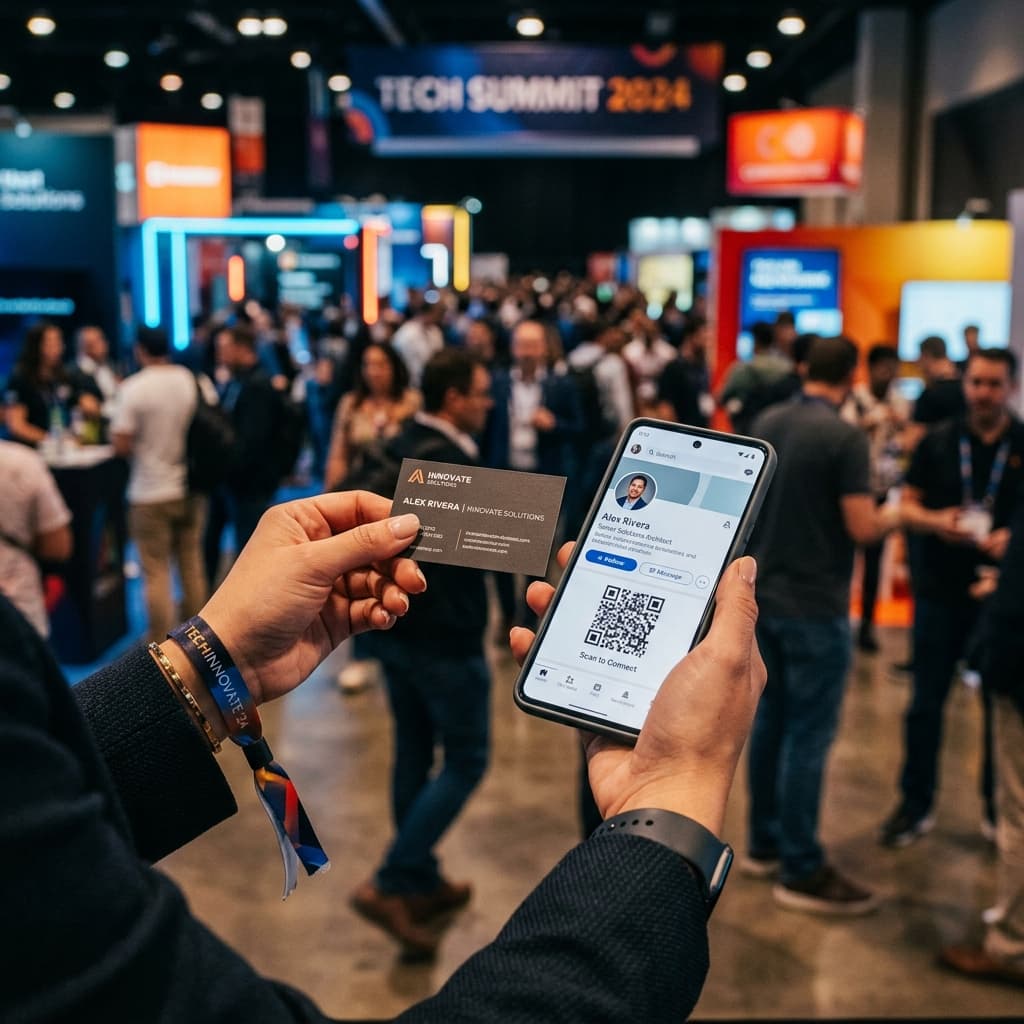
At SXSW 2026 I swapped LinkedIn connections, scanned QR codes, tapped NFC tags, and still ended up with a handful of paper business cards in my jacket. Five different methods in five days. With all the advancements in AI, why hasn't anyone solved this yet — and is something better finally on the horizon?
Five Days, Five Formats
SXSW 2026 was everything you'd expect — loud, chaotic, brilliant, and exhausting. But looking back, the thing that struck me most wasn't a keynote or a demo. It was the absurd variety of ways people tried to exchange contact information.
Over five days I:
- Accepted LinkedIn connection requests on the spot, thumbs fumbling on a too-bright screen in a dim bar
- Scanned QR codes printed on lanyards, stickers, phone cases, and one person's actual t-shirt
- Tapped my phone against NFC-enabled cards and wristbands
- Typed my email into someone's digital card app that I'd never heard of and will probably never open again
- And yes — received a handful of good old paper business cards, crisp and confident in their simplicity
Five different formats. Five different friction points. Zero interoperability between any of them.
We've built AI that can write code, compose music, and diagnose diseases. But we still can't agree on how two professionals should swap phone numbers at a conference.
Why is there no single standard for exchanging business contact information?
Answer: Despite decades of digital alternatives, no single standard has emerged because the problem isn't technical — it's structural. The vCard format exists as a base standard, but modern networking demands richer data (analytics, CRM integration, real-time updates) that no open standard supports. Meanwhile, every platform — LinkedIn, HiHello, Popl, Blinq — profits from keeping users inside its own ecosystem. Add cultural differences, generational preferences, and the sheer inertia of a 3.5 × 2 inch piece of cardstock, and you get the fragmented landscape we're living in today.
The Contenders — And Why None of Them Have Won
Let's be honest about where each format stands in 2026.
LinkedIn: The Default That Nobody Loves
LinkedIn is the closest thing we have to a universal professional identity. Almost everyone at SXSW had a profile. But "let me find you on LinkedIn" is a terrible in-person experience.
You pull out your phone. You open the app. You wait for it to load. You search their name. There are six Sarah Chens. You hand your phone over so they can find the right one. They send a request. You accept it later. Maybe.
The connection is made, but no context travels with it. Sarah Chen is now one of your 2,400 connections, indistinguishable from the recruiter who cold-added you in 2019. You have no record of where you met, what you discussed, or why you should follow up.
LinkedIn solves discovery. It does not solve connection.
QR Codes: Frictionless but Fragile
QR codes had a genuine moment during the pandemic, and they've stuck around. They're accessible — everyone has a camera. They're fast. They work without an app.
But what happens after you scan? That depends entirely on what's behind the code. Maybe it's a vCard download. Maybe it's a landing page. Maybe it's a Linktree. Maybe it's a PDF of someone's résumé (yes, this happened to me).
The QR code is a delivery mechanism, not a solution. It's a door that might open into a mansion or a broom closet, and you don't know which until you've already scanned.
NFC: Elegant but Exclusive
Tap-to-share is genuinely the best physical experience available right now. You tap your card or wristband against someone's phone and your digital profile appears. It feels like the future.
Except it requires hardware. You need an NFC-enabled card or tag, which means you've committed to a specific provider — Popl, Dot, TapTok, or one of the dozen others. Some people I met at SXSW had two different NFC cards from two different services, because they'd switched providers and never got around to deactivating the old one.
NFC is the best answer if both parties are bought into the same ecosystem. Which, at a conference with thousands of strangers, they almost never are.
Paper: The Cockroach of Networking
And then there's paper. The format that every tech founder loves to declare dead — and then quietly orders a box of 500 from Moo before their next conference.
Paper cards work because they require nothing from the recipient. No app. No phone. No charged battery. No account. You hand over a rectangle and the transaction is complete.
The problem, of course, is everything that happens next. The card goes in a pocket. The pocket goes through a wash cycle. Or the card makes it to a desk, joins a pile, and slowly becomes a stranger. 88% of business cards are thrown away within a week. We know this. And yet paper persists, because the moment of exchange is effortless.
Why a "Golden Standard" Hasn't Emerged
The answer is simpler and more frustrating than you'd think: everyone is solving a different problem.
The Platform Incentive Problem
LinkedIn wants you in LinkedIn. Popl wants you in Popl. HiHello wants you in HiHello. Each platform builds features that lock you deeper into its ecosystem — analytics dashboards, team management, CRM syncs — because that's where the subscription revenue is.
An open, interoperable standard would let you switch providers freely, and no provider wants that. It's the same reason there's no universal messaging app despite thirty years of trying. The business model depends on the walled garden.
The vCard Is a Relic
The vCard (.vcf) format is technically the ISO standard for contact exchange. It was designed in 1995. It handles names, phone numbers, and email addresses reasonably well. It handles everything else — social profiles, portfolio links, scheduling integrations, pronouns, preferred communication channels — poorly or not at all.
Every modern digital card platform extends vCard with proprietary fields, which means the "standard" part of the standard only covers the basics. The useful stuff lives in the extensions that only work within that platform.
Culture Eats Protocol
In Asia, the physical card is a cultural ritual. In Silicon Valley, a LinkedIn QR code is the norm. In the creative industries, people share Instagram handles. In finance, they still pass Rolodex-ready cardstock.
A golden standard would need to satisfy a Japanese executive presenting a card with both hands and a Gen Z founder who thinks email is dead. That's not a technology problem. That's a human behavior problem.
What AI Actually Changes
Here's where it gets interesting. Because while AI hasn't produced a golden standard for exchanging contacts, it's quietly solving the more important problem: what happens after the exchange.
The Real Problem Was Never the Format
Think about it. Whether you collect a paper card, a LinkedIn connection, or an NFC tap, the failure point is identical: the information enters a black hole.
You leave the conference with 40 new contacts in four different formats scattered across three apps, a jacket pocket, and your phone's photo roll. Some have context. Most don't. All of them are decaying in value with every hour you don't act on them.
The format of the exchange is a distraction. The real problem is consolidation, enrichment, and action.
AI as the Universal Adapter
This is what AI is genuinely good at — not replacing the business card, but making every format equally useful regardless of how it arrived.
Consolidation: AI can ingest a paper card (via OCR), a LinkedIn profile (via URL), a QR code landing page, and an NFC-generated vCard, and normalize all of them into a single, structured contact record. The input format stops mattering because the processing layer is format-agnostic.
Enrichment: A name and company on a card is a starting point. AI can cross-reference that against public data — LinkedIn, company websites, press mentions, funding announcements — to build a richer picture before you've even written the follow-up.
Context preservation: This is the one AI unlocks that nothing else can. You add a voice note or a few quick keywords after a conversation — "met at SXSW, interested in our API, launching in Q3, loves cycling" — and AI turns those fragments into a structured contact profile with a personalised follow-up draft ready to send.
Action: AI doesn't just store the contact. It prompts you to act. Follow-up email drafted. Meeting link suggested. Reminder set for the second touch. The gap between "we should stay in touch" and actually staying in touch collapses from days to minutes.
The Shift from Format to Intelligence
The AI insight is that the golden standard doesn't need to be a format at all. It needs to be an intelligence layer that sits above every format.
If your system can process a paper card, a QR code, a LinkedIn URL, and an NFC tap with equal accuracy and attach context to all of them, then the format question becomes irrelevant. Use whatever the person in front of you prefers. The output is the same: a rich, actionable contact with context and a follow-up plan.
That's not a future prediction. That technology exists today. The pieces are assembled. The question is adoption.
What's Actually on the Horizon
If I had to bet on what changes in the next two to three years, here's where I'd put my money:
1. Ambient Contact Exchange
The SXSW GO app already experimented with proximity-based networking — alerting you when a relevant contact was nearby. The next step is passive exchange: you walk into a room, your device negotiates with nearby devices, and relevant professional profiles surface on your screen without either party pulling out a phone.
Apple's NameDrop is the consumer preview of this. A professional version — privacy-respecting, opt-in, context-aware — is inevitable.
2. AI-Generated "Living Profiles"
Static profiles are dying. Your LinkedIn headline was written eighteen months ago and describes a role you no longer have. A living profile, maintained by AI, updates itself based on your latest projects, publications, speaking engagements, and even the specific conference you're attending right now.
When someone connects with you at a trade show, they don't get your generic profile — they get a contextualised snapshot relevant to that event and that industry.
3. Post-Event Intelligence Reports
Instead of leaving a conference with a stack of contacts you'll never process, AI compiles them for you. An overnight report: here are the 42 people you connected with, ranked by relevance, with context from your conversations, recommended follow-up actions, and draft messages. You wake up, review, approve, and your pipeline is warm before breakfast.
4. The Death of the "Connection Request"
The most antiquated ritual in digital networking: "I'd like to add you to my professional network on LinkedIn." The future is mutual, contextual, and continuous. You met. The AI knows it. The context is captured. The relationship is tracked. No request needed. No inbox noise. Just a warm, documented connection that both parties can act on when the time is right.
So Should You Still Carry Business Cards?
Yes. Absolutely. Carry them to every conference, every dinner, every "casual drinks" that might turn into a business conversation.
Not because paper is the best technology — it obviously isn't. But because the person standing in front of you might prefer paper. Or LinkedIn. Or a QR code. Or an NFC tap. And until there's a universal layer that makes the format irrelevant (which is closer than you think), the path of least friction is to be ready for all of them.
The card you give is a courtesy. The card you receive — in any format — is only as valuable as what you do with it in the next 48 hours.
What SXSW Taught Me (Again)
I left Austin with 67 new contacts. Paper cards in my bag. LinkedIn connections in my feed. QR-code bookmarks in my browser. NFC-generated vCards in my contacts app.
Before the flight home I processed all of them through DigiClone — paper, digital, it didn't matter. Fifteen minutes. Every contact consolidated, enriched, contextualised, and queued for follow-up.
By the time I landed, twelve people had already replied to personalised follow-ups that referenced our actual conversations. Not "great to meet you" templates. Real messages with real context.
The golden standard for business cards isn't a format. It isn't a protocol. It isn't a card at all.
It's the system that catches everything — regardless of format — and turns it into a relationship before the memory fades.
Back from a conference with contacts scattered across five different formats? See how DigiClone consolidates and activates all of them in minutes.
Ready to stop losing opportunities?
Join thousands of high-performing professionals who have digitized their networking pipeline with DigiClone.