Your Post-Conference Checklist: 5 Actions Before You Unpack
The most valuable hour after a conference isn't the closing keynote—it's what you do before you get home. Here's your checklist for turning event contacts into real opportunities.
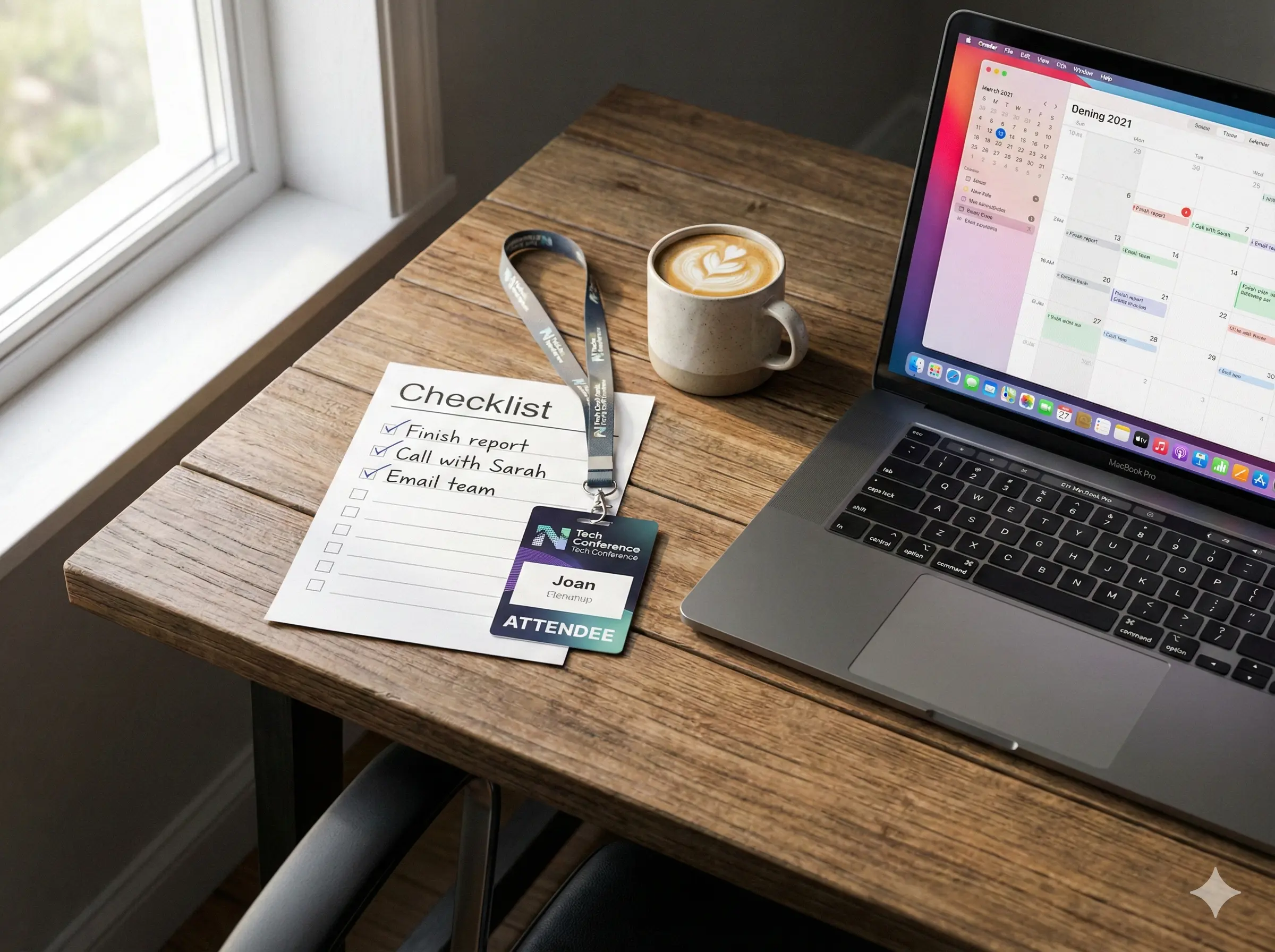
You're exhausted. Your feet hurt. Your brain is overloaded with new ideas, new faces, and new possibilities. All you want to do is get home, take off your shoes, and collapse on the couch.
But here's the truth: the next 60 minutes will determine whether this conference was worth it.
Not the sessions you attended. Not the keynotes you heard. Not even the conversations you had. What matters now is what you do with all of it—before the momentum fades and real life takes over.
What should I do immediately after a conference?
Answer: The most critical post-conference actions are: digitize all business cards, add context notes while memories are fresh, send brief "great to meet you" messages, flag high-priority contacts for detailed follow-up, and schedule your follow-up session. These five actions, done within hours of leaving the venue, dramatically increase conversion rates from event contacts.
Why the First Hour Matters
Conference ROI isn't measured in sessions attended—it's measured in relationships converted.
And conversion has a half-life. Research on networking follow-up shows:
- Within 24 hours: Connection feels fresh, context is intact, response rates are highest
- 24-48 hours: Still warm, but you're competing with their post-event inbox flood
- 48-72 hours: Going cold; they're back to normal life and you're becoming a vague memory
- Beyond 72 hours: You're now "someone from that conference"—if they remember at all
The first hour after you leave the venue is the highest-leverage time you have. Use it.
The 5-Action Post-Conference Checklist
Do these five things before you unpack your suitcase. In the Uber. At the airport. On the train home. Wherever you are—this is the work that matters.
1. Digitize Every Card (5-10 minutes)
Empty your pockets, your badge holder, your bag. Get every card in one place.
Now digitize them. All of them. Not "the important ones"—all of them. You don't know yet which connection will matter most.
Why this can't wait:
- Cards get lost, damaged, or forgotten in jacket pockets
- The longer you wait, the more "one-by-one scanning" feels like a chore
- Bulk capture now takes minutes; manual entry later takes hours
Pro tip: Use a tool that captures multiple cards at once. One-by-one scanning at the airport is a recipe for giving up halfway through.
2. Add Context Notes (10-15 minutes)
This is the step most people skip—and it's the most valuable.
For each contact, capture:
- Where you met: "Day 2, after the AI panel" or "Networking drinks, introduced by Mark"
- What you discussed: "Their Q2 product launch, needs help with go-to-market"
- What you promised: "Send the article about pricing strategies"
- Potential opportunity: "Possible consulting engagement, March timeline"
- Personal details: "Has a golden retriever named Max, running a marathon in April"
This takes 30-60 seconds per contact. It will save you 10 minutes of confused staring when you write the follow-up email tomorrow.
Why this can't wait:
- Context evaporates faster than you think
- By tomorrow, "Sarah from the fintech panel" becomes "someone named Sarah"
- Personal details that build rapport are the first to fade
3. Send Quick "Great to Meet You" Messages (15-20 minutes)
You don't need to write a detailed follow-up right now. You just need to establish the thread.
A quick message does three things:
- Puts your name in their inbox while they still remember you
- Creates a conversation thread you can continue tomorrow
- Signals that you're someone who follows through
Template:
Hey [Name] — Great meeting you at [Conference] today. Really enjoyed our conversation about [specific topic]. Let's definitely continue the conversation once we're both recovered from conference brain. Talk soon!
That's it. 30 seconds to write. No ask. No pitch. Just a timestamp on the connection.
Send via: LinkedIn message, email, or both. LinkedIn is faster if you're walking; email is better if you have a few minutes.
Why this can't wait:
- They're also processing their conference contacts right now
- Being first in their inbox makes you memorable
- A message today beats a perfect email next week
4. Flag Your Priority Contacts (5 minutes)
Not all contacts are equal. Some are "nice to stay in touch" and some are "this could change my business."
Review your list and flag the top 5-10 contacts who deserve a more substantial follow-up. These are the people you'll write personal, thoughtful emails to tomorrow—not today, when you're exhausted.
Priority criteria:
- Clear business opportunity in the next 90 days
- Decision-maker or strong referral potential
- Strong personal connection or shared values
- Someone you explicitly promised to follow up with
Why this can't wait:
- Energy and enthusiasm fade; capture your instincts now
- You'll forget who felt "high priority" in the moment
- Tomorrow's follow-up session needs a clear focus
5. Schedule Your Follow-Up Session (2 minutes)
Open your calendar. Block 60-90 minutes tomorrow or the day after. Label it: "Conference Follow-Up — DO NOT MOVE."
This is when you'll:
- Write detailed follow-ups to priority contacts
- Send any materials you promised
- Connect on LinkedIn with everyone you haven't yet
- Add contacts to your CRM or tracking system
Why this can't wait:
- If it's not on the calendar, it won't happen
- "I'll do it this weekend" is a lie you tell yourself
- Scheduling now, while you feel the urgency, creates commitment
The Complete Timeline
Here's how this looks in practice:
| When | Action | Time Required | |------|--------|---------------| | Leaving venue | Digitize all cards | 5-10 min | | In transit | Add context notes | 10-15 min | | In transit | Send quick messages | 15-20 min | | In transit | Flag priority contacts | 5 min | | In transit | Schedule follow-up session | 2 min | | Total | | ~45 minutes |
| Next day | Detailed follow-ups to priority contacts | 60-90 min |
45 minutes of focused work turns a €2,000 conference investment into actual pipeline. Skip it, and you've just paid for expensive inspiration that never converts.
What Happens If You Wait
Let's be honest about the alternative.
Day 1 (Conference ends): "I'll do follow-ups this weekend when I have time."
Day 2: Back-to-back meetings. Client fires. You'll definitely do it tonight.
Day 3: Too tired. Weekend for sure.
Day 5 (Weekend): Family stuff. Life stuff. You'll carve out time Sunday evening.
Day 7: Open the stack of cards. Can't remember who half these people are. The context is gone. Writing a follow-up now feels awkward. "Maybe I'll just connect on LinkedIn."
Day 14: Cards are in a drawer. You've moved on. The conference is a memory. The opportunities are gone.
This isn't a failure of character. It's a failure of systems. The only way to beat it is to act before you need willpower.
How DigiClone Makes This Automatic
We built DigiClone for exactly this moment—the hour after the conference when everything is possible but nothing is captured.
- Bulk digitization: Photograph your entire card stack at once. No one-by-one scanning.
- Context capture: Add notes about where you met and why they matter—right in the app.
- AI extraction: Names, emails, titles, companies pulled automatically. No typing.
- Quick follow-up drafts: AI-generated "great to meet you" messages based on your context notes.
- Priority flagging: Mark hot leads for tomorrow's detailed follow-up.
- CRM sync: Contacts land in Salesforce or HubSpot automatically.
The goal: complete steps 1-4 of this checklist in under 20 minutes, while you're still in the Uber home.
Your next conference deserves better than a drawer full of forgotten cards. Try DigiClone free and make post-event follow-up automatic.
Ready to stop losing opportunities?
Join thousands of high-performing professionals who have digitized their networking pipeline with DigiClone.