
Trade Show ROI: The Follow-Up Math Nobody Does
You spent €5,000 on that trade show booth. You collected 200 business cards. But how much revenue did you actually generate? Most exhibitors have no idea—and that's exactly the problem.
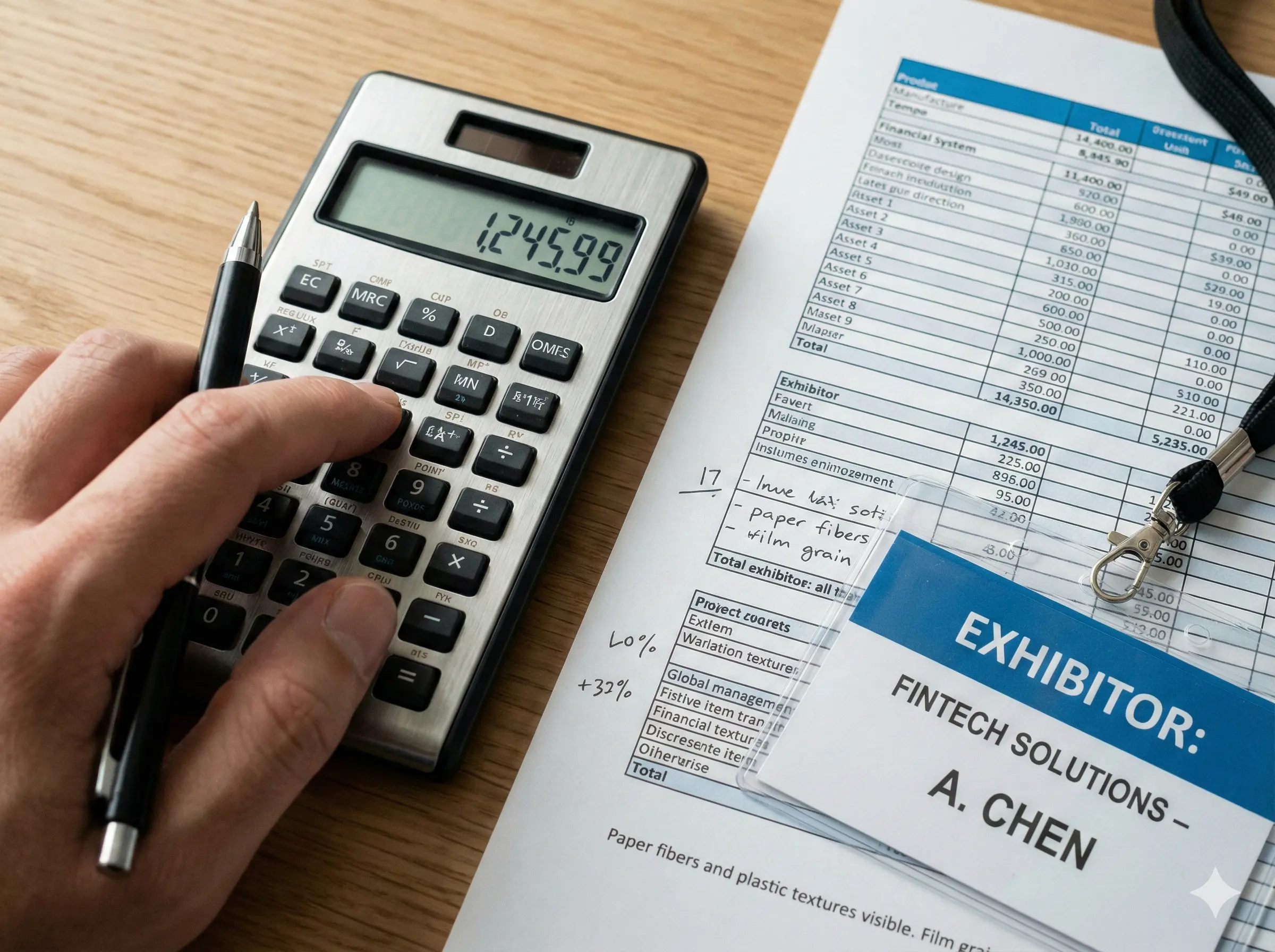
You just got back from the trade show. Your feet are destroyed. Your voice is gone. But you're feeling good—you collected 200 business cards. Maybe 300. The booth was busy. People were interested.
Your boss asks: "How did it go?"
You say: "Great! We got a ton of leads."
Three months later, your boss asks: "What came from the trade show?"
You say: "Uh... let me check."
You check. You have no idea. The cards are somewhere. Some got entered into the CRM. A few people maybe got emails. Did any of them convert? You honestly can't say.
This is the trade show ROI problem. Everyone tracks the cost. Nobody tracks the return.
How do you calculate trade show ROI?
Answer: Trade show ROI is calculated as: (Revenue Generated - Total Cost) / Total Cost × 100. However, most exhibitors fail to track this because they lose the connection between leads collected and deals closed. The key is attributing revenue back to specific events through disciplined follow-up tracking and CRM tagging from day one.
The Real Cost of a Trade Show
Before we talk about return, let's talk about investment. Most companies massively underestimate what they actually spend.
Direct Costs
| Item | Typical Range | |------|---------------| | Booth space | €2,000 - €20,000 | | Booth design/build | €1,000 - €15,000 | | Shipping & logistics | €500 - €3,000 | | Travel (flights, hotels) | €1,000 - €5,000 per person | | Meals & entertainment | €500 - €2,000 | | Marketing materials | €500 - €2,000 | | Giveaways/swag | €300 - €1,500 |
Hidden Costs
What most people forget:
- Opportunity cost: 2-4 days of your best salespeople not selling
- Preparation time: 20-40 hours of planning, design reviews, logistics
- Recovery time: The day after when everyone is exhausted and unproductive
- Follow-up time: The hours (or days) spent processing leads afterward
The Real Number
For a mid-sized company sending 2-3 people to a major trade show:
Visible cost: €8,000 - €15,000 True cost (including time): €15,000 - €30,000
That's a significant investment. What return should you expect?
The Follow-Up Failure Rate
Here's where it gets painful.
Industry Benchmarks
Research on trade show follow-up reveals a disturbing pattern:
- 79% of trade show leads are never followed up
- Average time to first follow-up: 8+ days (when it happens at all)
- Only 5-10% of exhibitors have a structured post-show follow-up process
Think about that. Nearly 8 out of 10 leads—people who walked up to your booth and expressed interest—never hear from you again.
Why Follow-Up Fails
The reasons are predictable:
- Everyone is exhausted after the show
- Business cards pile up waiting for data entry
- Context is lost ("Who was the person interested in the API?")
- No clear ownership for follow-up
- Urgent work accumulated during the show takes priority
The result: leads go cold, opportunities die, and the trade show investment generates a fraction of its potential return.
The Math Nobody Does
Let's run the actual numbers. This is the calculation most companies avoid.
Scenario: A Typical Trade Show
Investment:
- Total cost (including time): €20,000
- Leads collected: 200 business cards
Industry-Average Follow-Up:
- Leads actually followed up: 42 (21%)
- Leads that respond: 10 (24% of those contacted)
- Leads that take a meeting: 4 (40% of responders)
- Leads that close: 1 (25% close rate)
- Average deal value: €15,000
Result:
- Revenue generated: €15,000
- ROI: (€15,000 - €20,000) / €20,000 = -25%
The trade show lost money.
The Same Show With Disciplined Follow-Up
Now let's see what happens with a real follow-up process:
Investment: Same €20,000
Disciplined Follow-Up (within 48 hours):
- Leads actually followed up: 180 (90%)
- Leads that respond: 54 (30%—higher because follow-up is timely)
- Leads that take a meeting: 22 (40% of responders)
- Leads that close: 5-6 (25% close rate)
- Average deal value: €15,000
Result:
- Revenue generated: €75,000 - €90,000
- ROI: 275% - 350%
Same show. Same booth. Same leads. 5-6x more revenue.
The only difference: what happened in the 48 hours after the show ended.
The 48-Hour Trade Show Sprint
The difference between negative ROI and 300%+ ROI comes down to one thing: speed.
Here's the follow-up sprint that transforms trade show economics:
Day 0 (Last Day of Show)
Before you leave the venue:
- Photograph all cards — bulk capture, not one-by-one
- Add context notes — who they are, what they need, what you promised
- Flag hot leads — the 10-20% that deserve immediate personal attention
Time required: 30-45 minutes
Day 1 (Travel Day)
On the flight or train home:
- Send quick messages to hot leads — "Great meeting you at [Show]. Let's find time next week."
- Draft follow-up templates — personalized by conversation topic
- Import contacts to CRM with proper source tagging
Time required: 1-2 hours
Day 2 (First Day Back)
Block the morning for follow-up:
- Send personalized emails to all leads — template + one personal line
- Connect on LinkedIn with a note referencing the show
- Send promised materials — that PDF, that case study, that intro
Time required: 2-3 hours
Day 3-7
- Second touch to non-responders — different channel or angle
- Schedule meetings with engaged leads
- Brief your team on hot opportunities
After day 7, you've done what 79% of exhibitors never do: actually followed up.
Tracking the Return
Follow-up is only half the equation. You also need to track what happens.
Tag Everything
When leads enter your CRM, tag them with:
- Event name and date
- Lead source: "Trade Show - [Event Name] 2026"
- Lead quality tier (hot/warm/cold)
- Conversation topic or interest area
Track the Pipeline
Create a simple tracking view:
| Lead | Status | Next Step | Days Since Show | |------|--------|-----------|-----------------| | Sarah Chen | Meeting scheduled | Demo Jan 15 | 5 | | Mike Johnson | Email sent | Follow up Jan 10 | 5 | | Lisa Park | Responded | Send proposal | 3 |
Calculate Actual ROI
At 30, 60, and 90 days post-show:
- Pull all deals tagged to the event
- Sum closed revenue + weighted pipeline value
- Calculate: (Revenue - Cost) / Cost
This is the number your boss actually wants—and the number most companies never calculate.
Why Most Companies Don't Do This
If the math is so clear, why doesn't everyone follow up properly?
The Friction Problem
Between "collecting the card" and "sending the email," there are too many steps:
- Find the card
- Read the handwriting
- Type into CRM
- Remember what you talked about
- Write a personalized email
- Actually send it
Each step is a point of friction. Each point of friction is an opportunity to quit.
The Exhaustion Problem
Trade shows are physically and mentally draining. The last thing anyone wants to do afterward is admin work. So the cards sit in a bag, the bag sits in a desk drawer, and the leads go cold.
The Ownership Problem
On a sales team, who owns trade show follow-up? The person who talked to the lead? The marketing team who organized the booth? The sales ops person who manages the CRM?
When everyone owns it, no one owns it.
How DigiClone Fixes Trade Show Follow-Up
We built DigiClone specifically for the post-event sprint—including trade shows.
Here's how it changes the math:
Bulk Capture (Day 0)
- Photograph your entire stack of cards at once
- AI extracts all contact data automatically
- No typing, no manual entry, no friction
Context Capture (Day 0)
- Add notes about each conversation
- Tag by interest area, product line, or priority
- Everything captured while memory is fresh
AI Follow-Up (Day 1-2)
- Generate personalized emails based on your notes
- Review, tweak, send—in minutes, not hours
- Every lead gets a message, not just the ones you remember
CRM Sync (Day 2+)
- Push contacts to Salesforce or HubSpot
- Automatic source tagging for ROI tracking
- Clean data from day one
The result: what used to take days now takes hours. What used to be 21% follow-up becomes 90%+. And that trade show that lost money? It becomes your highest-ROI marketing channel.
The Bottom Line
Trade shows are expensive. But they're not expensive because of the booth or the travel or the swag.
They're expensive because of the revenue you leave on the table when you don't follow up.
The math is simple:
- 200 leads × no follow-up = negative ROI
- 200 leads × disciplined 48-hour follow-up = 300%+ ROI
Same investment. Radically different return.
The only question: what happens in the 48 hours after you leave the venue?
Make your next trade show actually profitable. Try DigiClone free and turn every card into a tracked, followed-up, revenue-generating opportunity.
Ready to stop losing opportunities?
Join thousands of high-performing professionals who have digitized their networking pipeline with DigiClone.